

| 2017-01-23 |    |
Free Tests for Joint Disease in New-born Lambs
With anecdotal evidence of an increase in “joint-ill” - a disease affecting the joints of young lambs - investigators from SRUC are offering free post mortem tests to sheep farmers and their vets.
Joint-ill, or septic arthritis, affects the joints of new born lambs and causes painful swelling. Those infected with the bacterial disease fail to thrive and, in the worst cases, up to 20% of the farm’s lamb crop can die.
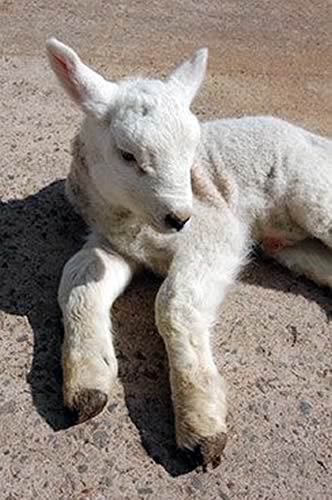
Lamb with swollen knees
Heather
Stevenson, specialist vet with SAC
Consulting Veterinary Services, said:
“Following the 2016 lambing season we had anecdotal
reports that there had been a greater than usual number of outbreaks
with high casualty rates and a poor response to treatments.
“We decide to collect up to date information from across the country about which pathogens are responsible for outbreaks and the most appropriate antibiotic to treat them with.”
As an easily recognised disease, farmers or their vets do not normally submit cases to any of the eight Veterinary Disease Surveillance Centres SAC Consulting runs on behalf of Scottish Government.
However Heather Stevenson believes the offer of free tests will help the college vets gather enough evidence for a proper scientific survey and analysis during the 2017 lambing season.
“Many different bacteria may be associated with septic arthritis although
historically one in particular - streptococcus dysgalactiae - has been
most common. It has been normal practice to use preventative antibiotic
treatments. But with increasing concerns about antimicrobial resistance
that approach is no longer acceptable and treatments must be more targeted.
“Hopefully our research will help in the development of Health Plans
with new prevention and control strategies.”
The researchers want to examine lambs from between 50 to 80 flocks - with one to three lambs submitted per flock. The lambs should be less than four weeks old.
The offer - on a first come, first served basis - is open to Scottish flocks and any English flocks close enough to the Veterinary Centres in Dumfries and St Boswells. Arrangements can be made to handle samples from flocks remote from any of the eight Scottish vet labs.