

2026-02-04 |
Solar Tracker Integrates with Traditional Farming
Until now, solar technology has struggled to adapt to the realities of UK agriculture. Fixed or low-mounted panels create too much shading for healthy pasture or crop growth, restricting land use. Hybrid solar tracking offers a way around these limitations, making agrisolar practical and viable for UK farms.
A recent case study at Our Cow Molly, Eddie Andrew’s Sheffield dairy farm, highlights the real-world performance of hybrid tracking. In late 2024, the farm installed Corrie Energy’s Latitude40 hybrid tracking system whose panels follow the sun throughout the day. Typically they delivered 30% more energy than fixed panels, and on 29 April 2025 the bifacial units generated 47% more energy per panel than the adjacent fixed array. Eddie said the system brought “really positive benefits for multiple reasons”. The main benefit for the farm team has been a generation profile that aligns with milking and processing, with boosted early-morning and late-afternoon output especially valuable for off-grid operations.
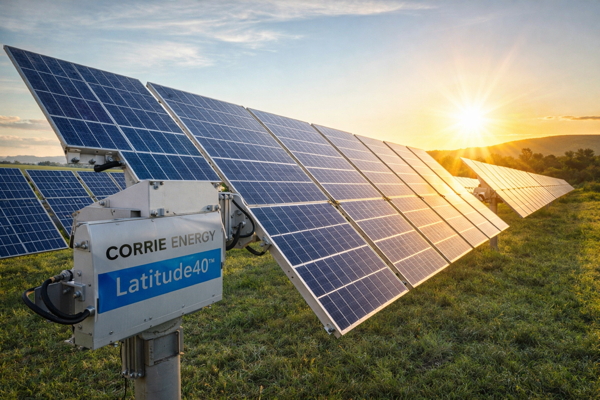
Corrie Energy’s Latitude40
hybrid tracking system.
Across the UK, farmland is under growing pressure from rising costs and climate change. With hybrid solar trackers, the same field can grow food and power your farm. That’s the idea behind agrisolar, the dual use of land for farming and solar energy.
Agrisolar allows crops, grazing animals, and solar panels to coexist, making farms more profitable while reducing the impact on the environment. According to recent research from the University of Sheffield, agrisolar systems could meet the UK’s entire solar energy demand more than four times over without reducing farmland. Consultants DW Energy state that farmland productivity could increase by up to 186% with agrisolar systems! The potential is enormous: greater land-use efficiency, improved soil health, and diversified income streams for farmers — all while driving progress toward Net Zero.
While traditional dual-axis trackers require expensive concrete foundations, a new generation of hybrid trackers have simple piled foundations and tripod structures. Installation uses standard equipment, making it accessible to UK contractors and farmers alike. Shade is minimal and constantly shifting, allowing crops to flourish beneath and between the panels. Since carbon sequestration is linked to grass growth, this also enhances soil health and supports positive environmental outcomes.
The benefits extend well beyond environmental credentials. Hybrid solar tracking enables farms to generate electricity on-site without removing land from production, helping to offset the significant and continuous power demand associated with crop storage. As well as lowering operational costs, this approach offers a practical route to diversify farm income while supporting a more secure and flexible energy supply for the sector.
Corrie Energy’s vision is clear: to make every acre work harder, producing food and clean energy side by side. With innovations like the Latitude40, agrisolar isn’t just a concept — it’s a new chapter for British farming.