

| 2013-03-27 |  |
Tweet |
Study Shows Appetite Genes are Key to Better Diets for Poultry
The welfare of poultry could be improved by a discovery about how chickens regulate their appetites.
Scientists have identified how a chicken’s genetic make-up can
affect the signals sent from its stomach to its brain that tell
a chicken when it has had enough to eat.
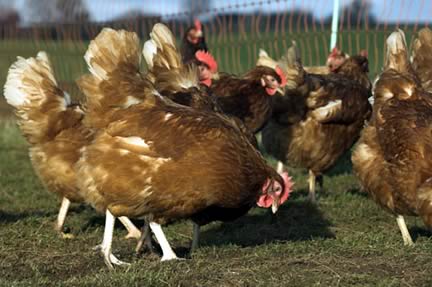
Poultry farmers often have to restrict food for chickens because
some birds are insensitive to feelings of fullness and can overeat,
affecting their ability to reproduce.
The study could make it easier to develop methods to develop diets
that reduce excess growth more naturally in these birds.
Researchers say that genetic differences, which affect when chickens
recognise when they have had enough to eat, could date back thousands
of years when chickens were first domesticated and breeds were
selected for their size.
The research was carried out by The Roslin Institute at the University
of Edinburgh.
Dr Ian Dunn, who led the study, said: “The findings shed greater
light on food intake in birds and help us understand why some breeds
– in general the faster growing types of chickens – are more insensitive
to feelings of fullness than others.”
The study, published in the American Journal of Physiology, Endocrinology
and Metabolism, focused on a protein called cholecystokinin (CCK)
that has a key role in sending signals linked to being full from
the gut to the brain.
The researchers, funded by the Biotechnology and Biological Sciences
Research Council, found that some birds were better equipped than
others at recognising the protein, making them more effective in
triggering signals of feeling full.
The study involved cross-breeding a fast-growing meat production strain
of chicken with a relatively slow-growing, chicken. The researchers
looked at how the protein was processed in both types of chickens and
in the new cross breed.
They showed that reduced levels of protein that recognizes the fullness
signal also affected the chicken’s natural body weight.
Their findings back up the theory that, when poultry were domesticated
thousands of years ago and bred for increased size, their appetite levels
were changed. The study could also help inform research looking at appetite
regulation in other animals.
Dr Dunn said: “All species regulate their appetites to make sure the
amount of food taken in is just the right to maintain body weight and
fat content. Our research has shown that there is genetic variation
in the interpretation of biological signals sent relating to being full.
This also affects what would be considered to be the natural body weight
of chickens.”