

| 2013-04-04 |  |
Tweet |
Greater consistency and precision in their most costly and important pesticide application could pay valuable dividends for potato growers at planting, suggests Agrii regional roots development manager, Peter Jones.
“Modern planting equipment is doing a fantastic job of improving potato seedbeds,” he reports. “But, in my experience, more needs to be done to make the most of its equally crucial role in nematicide application. After all, at £400 to £650/ha, we’re talking about the crop’s single most expensive pesticide treatment. And less-than-ideal control of potato cyst nematode (PCN) and spraing (tobacco rattle virus) can be even more costly in both yield losses through early senescence and rejections.
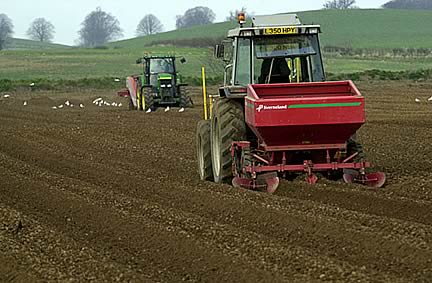
“To effectively protect the crop, granular nematicides need to be incorporated at exactly the right concentration and in the right place within the seedbed. Where PCN is the problem even distribution in the soil surrounding the seed is the key, while a more localised but equally even in-furrow spread around the seed is required for free-living nematode reduction. The microscopic nature of both pests means they can gain access to the crop wherever the defensive nematicide barrier is either diluted in too much soil or too little.”
Despite this clear agronomic need, Peter Jones finds nematicide
application during either bed formation or stone-picking can be
inconsistent due to variations in soil type, depth of working and
moisture content. He also often sees in-furrow applications giving
less-than-ideal granule distribution beneath and around the seed
due to physical interference from planter sides and variations in
planting depth.
“Remember, every slight change in soil type means a shift in tractor
and machinery depth, changing the amount of soil being moved and,
with it, granule concentration,” he points out.
“That such practicalities can make a valuable difference is clearly illustrated by assessments of different bed treatment techniques we made on a very high PCN site in the Midlands last season.
“Where a nematicide applicator was incorporated on a front-mounted
tiller ahead of the planter we extended the growing period by three
weeks. That was an extra yield of around 7.5 t/ha simply through better
nematicide placement. The kit wasn’t cheap, but it more than paid for
itself in improved performance in the one year.”
Alongside such bed treatment gains, Peter Jones is keen to secure similar
improvements with in-furrow nematicide application. In particular, he
believes there has to be much greater dialogue between machinery manufacturers
and agronomists in this important area. And he urges growers to consider
nematicide needs as much as seedbed quality in their equipment selection
and use.
“We all need to make sure we apply the vital, effective and expensive
nematicides available to us in the best possible way,” he stresses.
“As well as being more concerned over key aspects of application system
design within their machinery, growers must be especially diligent in
their equipment use – in particular, adjusting working depth with every
change in soil condition for the most accurate planting.
“We need to remember that treatment ahead of planting is the only option
we have to control nematode problems,” he concludes. “Once our potatoes
are in the ground we just have to live with the consequences.”